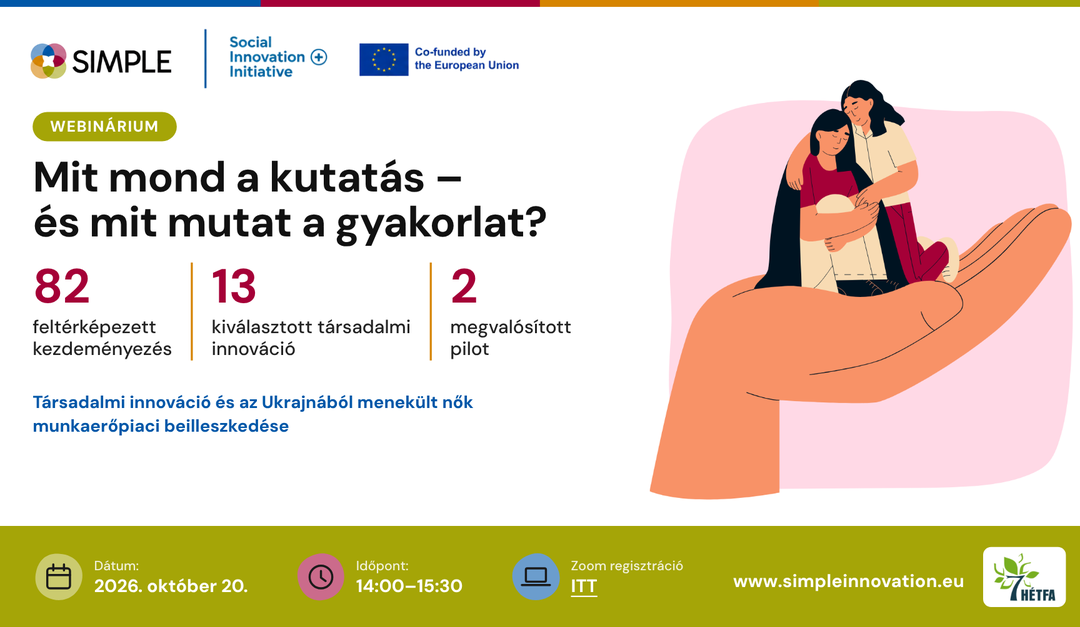
On 20 October, HÉTFA, a partner in the SIMPLE project, organised a webinar entitled “What Does the Research Tell Us – and What Does Practice Show?”
The SIMPLE – Social Innovation Models to Promote Learning and Employability – project aims to identify, adapt and support the wider use of promising social innovation practices that strengthen the labour-market integration and social inclusion of refugees from Ukraine.
As part of the project, 82 European initiatives were mapped, of which 13 were examined in greater depth. The analysis informed two pilot programmes testing different approaches to labour-market integration. In Poland, the programme focused on entrepreneurship skills and support for participants considering self-employment, while in Italy it centred on job-search support, pathways into employment and engagement with employers.
The webinar examined the limitations of the available research and the additional insights that emerge through implementation in practice. It also addressed a central question for SIMPLE: how far approaches developed in one context can be transferred to another, which elements need to be adapted to local institutional and social conditions, and what can reasonably be inferred from the outcomes of relatively short-term interventions. The discussion also considered the relevance of these findings for organisations and practitioners working in comparable fields in Hungary.
The webinar was presented by Evelin Verhás of HÉTFA Research Institute.
The recording is available in Hungarian here: SIMPLE – Social Innovation for Migrant Integration and Employability
The SIMPLE project is co-funded by the European Union through the ESF+ Social Innovation+ Initiative.
Further information about the SIMPLE project is available on the project website.
Funding statement
Funded by the European Union. Views and opinions expressed are those of the author(s) only and do not necessarily reflect those of the European Union or the European Social Fund Agency (ESFA). Neither the European Union nor the Granting Authority can be held responsible for them.