
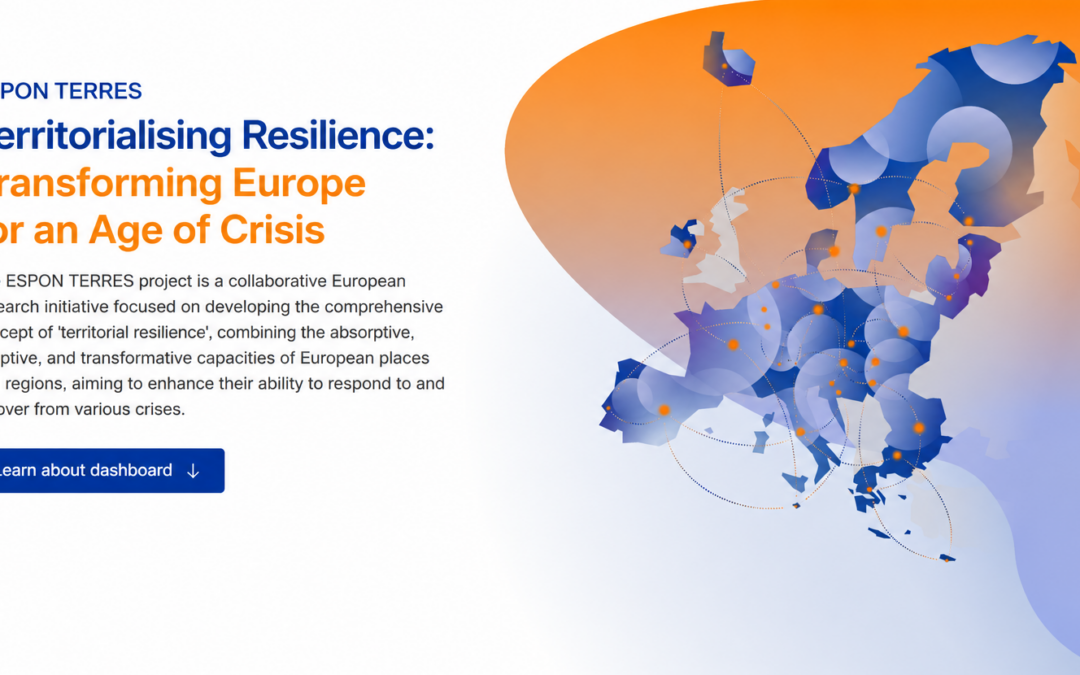
The Territorial Resilience Dashboard has been released in connection with the ESPON TERRES (Territorialising Resilience: Transforming Europe for an Age of Crisis) research project coordinated by the HÉTFA Research Institute, with the participation of our colleagues and researchers from Nordregio, Politecnico di Torino, ARUP, and Mcrit.
The dashboard presents the concept of territorial resilience (Conceptualization), a comprehensive, interactive statistical interface that displays indicators of territorial resilience in Europe at the regional level (Statistics), the different stories of how resilience has been manifested and interpreted in various territorial contexts (Stories), the results of the case studies conducted within the project (Case Studies), the assessment tools developed (Assessment), and related terminology (Documentation – Glossary). The further results of the research (including the Final Report) are publicly available on the ESPON website.
In recent years, the concept of “resilience” has become embedded in the policy discourse of the European Union, but there’s still no common agreement on the actual meaning of the term and its application in territorial governance practice. The aim of the ESPON TERRES project was to fill this research gap and develop a conceptual framework for “territorial resilience,” outlining a measurement methodology that could potentially help guide EU cohesion and other sectoral policies, particularly at the subnational level.
As a result, the project team defined a comprehensive concept of territorial resilience, reviewed its current policy applications and possibilities, compiled a set of indicators suitable for measuring territorial resilience, and developed recommendations for future data collection. Analysed and mapped territorial inequalities in resilience; formulated recommendations for future research and methodology; and prepared an online dashboard to support the interpretation and measurement of territorial resilience.
Six case studies were also prepared within the framework of the project: HÉTFA staff addressed the challenges of the Budapest functional urban area, including intensive suburbanization and urban sprawl, overburdened infrastructure, public services and natural environment, and fragmented governance. To address these challenges, the project proposed a framework to strengthen cooperation and commitment among governance actors. The Budapest case identified valuable new initiatives, promising forms of cooperation, and the high added value of informal relationships, highlighting the role of proactive actors in resilience.