
Introducing DISCERN-AI
How can youth workers help young people navigate AI-generated content and recognise disinformation? This question is at the heart of DISCERN-AI: AI Literacy for Disinformation-Resilient Youth Work, a new Erasmus+ project bringing together five organisations from across Europe.
Artificial intelligence is increasingly part of how people find, create and interact with information online. While AI tools offer opportunities for learning and creativity, they can also make it easier to produce convincing content that is inaccurate or deliberately misleading. Youth workers have an important role in helping young people engage critically with this changing information environment.
DISCERN-AI aims to strengthen youth workers’ AI literacy and provide them with practical tools to support young people’s critical thinking and resilience to disinformation. To do so, the partners will:
- Map youth workers’ competences and training needs, and create an online repository of good educational practices for youth workers.
- Develop and test training materials with youth workers and young people, using their feedback to refine a multilingual training manual.
- Bring practitioners and decision-makers together to exchange perspectives and inform policy recommendations for the youth sector.
HÉTFA leads two work packages in DISCERN-AI. The first (WP2) brings together research, good practice collection and the development of training materials to strengthen AI literacy in youth work. HÉTFA will develop a common methodology, coordinate the mapping of youth workers’ competences across the partner countries and prepare a transnational report to inform the training materials.
HÉTFA also leads the work package on European outreach, stakeholder engagement and sustainability (WP5). In this role, the Institute coordinates communication and dissemination across the partnership, helping the project’s findings and resources reach youth workers and other relevant stakeholders.
Kick-off Meeting in Cluj-Napoca
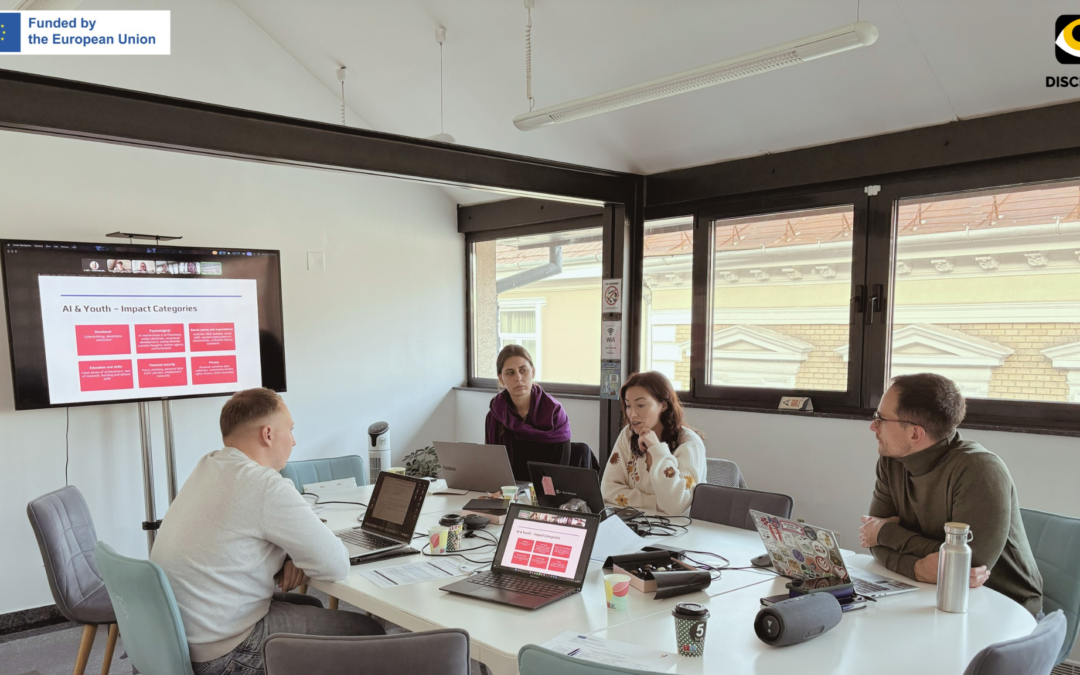
The DISCERN-AI partners met in Cluj-Napoca on 5–6 November 2026 for a kick-off meeting. The meeting focused on developing a shared approach to support youth workers in strengthening AI literacy and responding to disinformation. Representing HÉTFA, Csenge Polgár presented the methodological approach to the data collection that will inform the development of the training materials, as well as the main activities of the two work packages led by HÉTFA.
Bringing together their experience in research, youth work and AI governance, the partners discussed how to build the training materials around the needs of youth workers and how the knowledge gained through the project could contribute to wider discussions on youth policy and practice.
Funded by the European Union. Views and opinions expressed are however those of the author(s) only and do not necessarily reflect those of the European Union or the Romanian National Agency for Community Programmes in the Field of Education and Vocational Training (ANPCDEFP). Neither the European Union nor ANPCDEFP can be held responsible for them.