
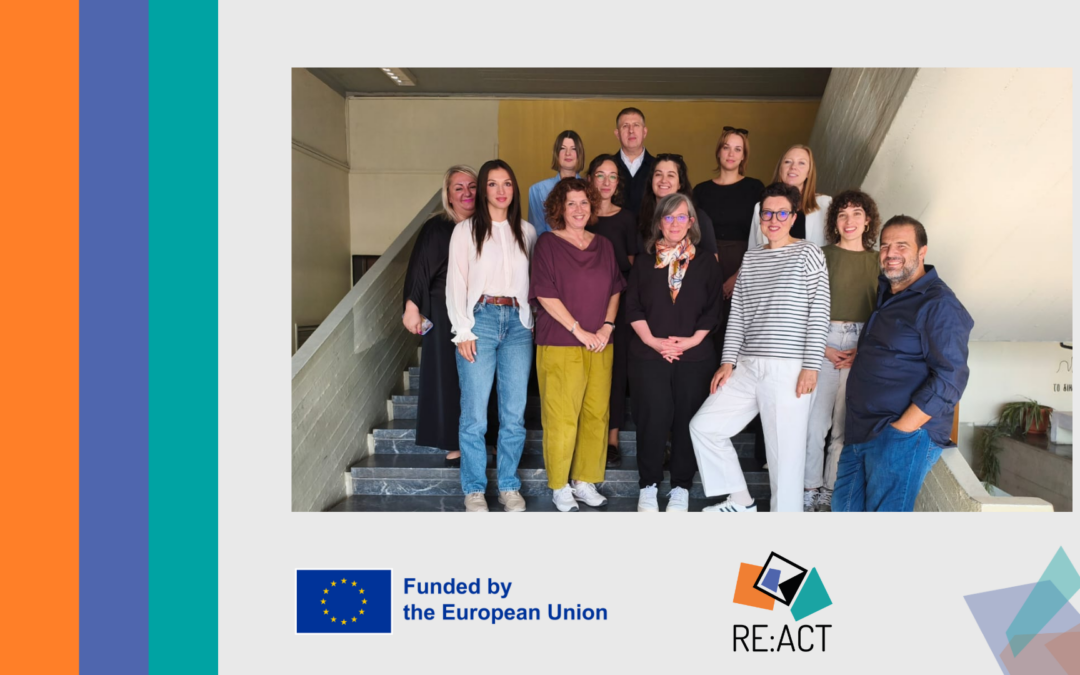
The kick-off meeting of RE:ACT – Resilience through Digital Education Against Contemporary Antisemitism and Distortion took place on 28–29 September 2026 at Aristotle University of Thessaloniki, Greece. The meeting brought together project partners from Hungary, Germany, Greece and Romania, together with associated partners from Switzerland and the United States to discuss the project’s objectives, work plan and initial activities. The project is co-funded by the European Union through the Citizens, Equality, Rights and Values (CERV) programme.
RE:ACT addresses the growing challenges of contemporary antisemitism, Holocaust distortion and online hate in Europe through innovative educational approaches. Building on the results of the DECONSTRUCT project, it connects Holocaust remembrance with present-day civic challenges and equips educators and young people with the knowledge and skills to recognise and counter antisemitic narratives, misinformation and prejudice. the project aims to strengthen educational responses to antisemitism and foster collaboration among educators, civil society organisations and other relevant stakeholders across Europe. The project places particular emphasis on strengthening critical thinking, enhancing media literacy, fostering empathy and democratic resilience.
As one of the project’s first activities, partners will conduct a baseline study to establish a comprehensive understanding of the current manifestations of antisemitism and existing educational responses in the partner countries. The study will also provide a reference point for assessing the effectiveness of the educational tools developed throughout the project and their broader societal impact. During the kick-off meeting, partners discussed project management, communication and dissemination, as well as the research methodology and the framework for assessing the project’s impact. The consortium also explored the processes for developing the YOUTHWITNESS Package, which will combine digital learning resources, testimony-based education, teacher training, mentoring and pilot activities. These initiatives will support educators and students in addressing contemporary antisemitism and Holocaust distortion in educational settings.
HÉTFA Research Institute supports project management, in close collaboration with the project coordinator, the Zachor Foundation for Social Remembrance. In addition it contributes in developing the research methodology, as well as responsible for conducting the baseline study and impact assessment.