
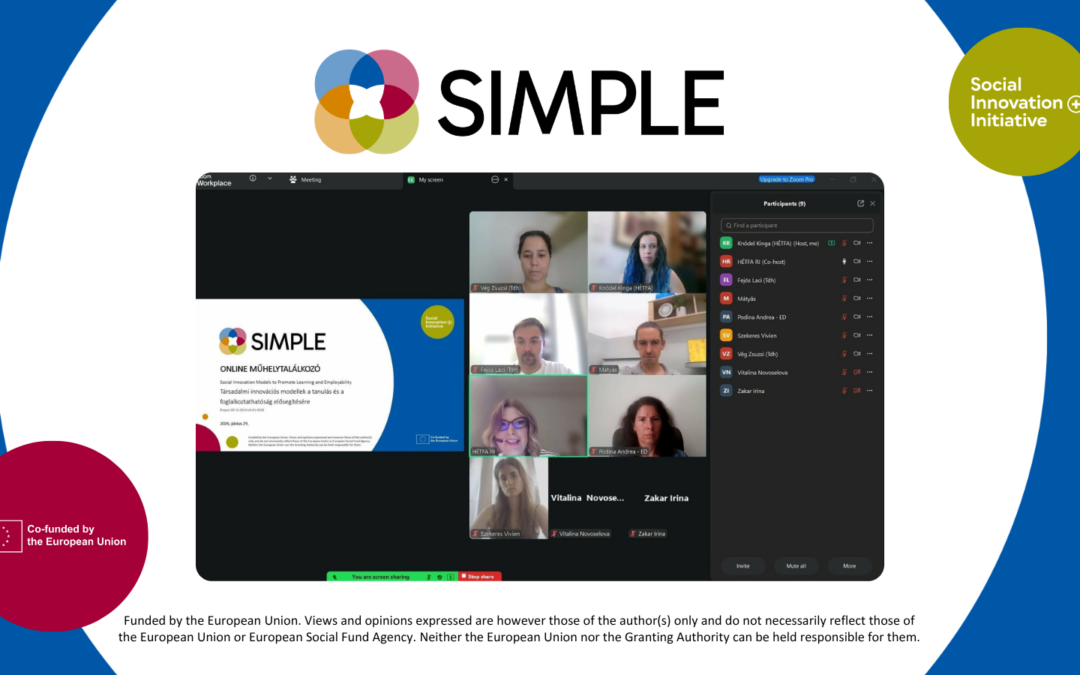
On 29 June, HÉTFA, a partner in the SIMPLE project, organised an online workshop bringing together Hungarian organisations working with refugees from Ukraine and first-hand perspectives shaped by displacement from Ukraine. Drawing on practical implementation experience, participants considered how to make knowledge exchange and cooperation across organisations more effective, and how to give those directly affected a meaningful role in shaping programmes designed to support them.
Participants examined the conditions under which knowledge exchange can become a genuine process of professional learning. They noted that exchanges between organisations often foreground results and successful approaches, while implementation difficulties, adaptations made during delivery and lessons from less successful approaches receive considerably less attention. Open and substantive exchange may also be constrained by limited time and capacity, institutional interests and competition for funding. Participants therefore considered what forms of cooperation and exchange can foster the trust required for organisations to share these experiences openly and enable others to draw relevant lessons for their own practice.
Participants also examined how refugees can play a genuine role in shaping programmes rather than being limited to commenting on programmes whose main parameters have already been defined. The discussion addressed participatory methods, the systematic use of participant feedback, and the ways in which hierarchical and dependency relationships can restrict meaningful participation. Participants also highlighted that differences in living circumstances, social position, minority status and forms of vulnerability can significantly shape needs and the barriers encountered in social inclusion. Inclusive programme design therefore needs to start from these differences and the distinct needs arising from them. Meaningful participation, in turn, means enabling refugees in different circumstances to bring their own experiences and perspectives to shaping programmes that affect them.
The SIMPLE – Social Innovation Models to Promote Learning and Employability – project is co-funded by the European Union through the ESF+ Social Innovation+ Initiative. Its aim is to identify, adapt and support the wider use of promising social innovation practices that strengthen the labour-market integration and social inclusion of refugees from Ukraine, with a particular focus on women.
For more information, visit: https://simpleinnovation.eu
Funded by the European Union. Views and opinions expressed are those of the author(s) only and do not necessarily reflect those of the European Union or the European Social Fund Agency (ESFA). Neither the European Union nor the Granting Authority can be held responsible for them.