
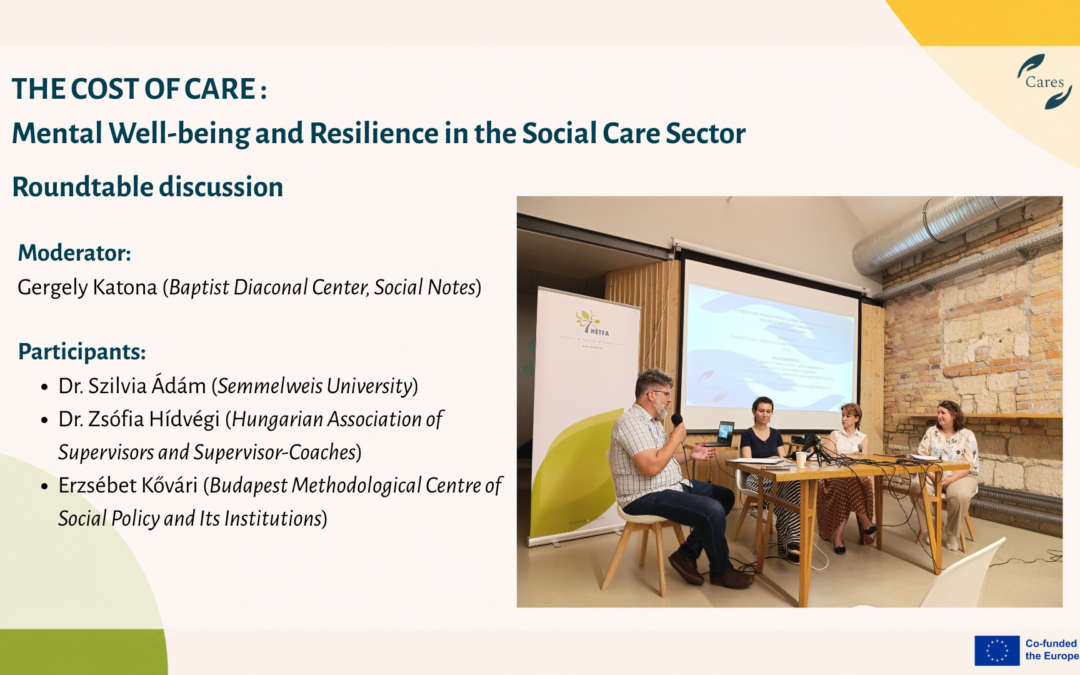
The mental health of care sector workers is not merely a private matter, but a cornerstone of the healthcare system’s functionality. On June 24, 2026, during a roundtable discussion organized by the HÉTFA Research Institute, experts explored the most pressing challenges facing the helping professions in Hungary and potential solutions. The event took place as part of the CARES (Caregivers Advancing Regulatory Environment and Skills) project, which aims to promote the mental well-being of those working in the social sector.
The Reality in Hungary
Moderator Gergely Katona (Baptist Diaconal Center, Social Notes) opened the discussion by presenting statistical data reflecting the current state of the sector. According to estimates, approximately 90,000 people work in the social welfare system in Hungary, but only 20% of them hold a college degree. Although official statistics show an average gross salary of around 582,000 Ft, workers tend to estimate it at around 400,000 Ft gross—due to the inconsistency of bonuses and other payments. Nationwide, there is a 20% labor shortage, which exceeds 40% in certain areas. Approximately 40% of those who earn a degree in this field do not find employment in the social sector even after graduation.
Resilience – more than flexibility
The central concept of the discussion was resilience. Dr. Szilvia Ádám (Semmelweis University) defined resilience as the ability that allows an individual or organization to recover—and even thrive—after a crisis. Erzsébet Kővári (Budapest Methodological Centre of Social Policy and Its Institutions) cited the COVID-19 pandemic, the refugee crisis, and the cost-of-living crisis as examples where effective communication and collaboration helped institutions. Dr. Zsófia Hídvégi (Hungarian Association of Supervisors and Supervisor-Coaches) emphasized from a neuroscientific perspective that humans are social beings, and thus connecting with others is an important means of calming the nervous system.
Why are colleagues leaving?
According to the experts, the reason for leaving the profession is not only salary, but working conditions, the lack of positive feedback and the workplace atmosphere. In 85–90% of supervision cases, the source of problems is not difficulties with clients, but collegial tensions and manager-subordinate relationships. The key to the solution lies in creating “psychological safety” – an environment where it is okay to make mistakes.
Supervision: not a luxury, but an essential in mental well-being
Supervision is an interprofessional reflective process that supports helpers’ mental well-being in four dimensions: me and my profession, me and my colleagues, me and my clients, and me and the system. The experts agreed that supervision should become part of professional socialisation. Erzsébet Kővári shared that at BMSZKI, centrally organised supervision has been available since 2020.
Good practices and personal strategies
Participants reported several forward-looking initiatives, including the BMSZKI and MOME collaboration, community psychiatry programmes, relaxation rooms for staff, and leadership training and resilience programmes. At the end of the discussion, the experts shared their own coping strategies: conscious self-care, grounding techniques, expanding reaction time, positive focus and supportive relationships all contribute to maintaining helpers’ mental balance.
The key takeaway of the roundtable discussion is that the sustainability of the helping professions requires “helping the helpers”. As we are taught on aeroplanes: we must put on our own oxygen mask first.
The podcast version of the Hunagrian discussion can be accessed here: https://www.youtube.com/watch?v=MgOClhaLRyA